
Guide
What Cold Does to Garage Door Springs in Morgantown
Morgantown homes built between 1938 and 2008 face severe cold winters that strain garage door springs and openers. Know when to call and when to wait.
Local detail
What the Weather Here Does to It
Morgantown sits in a climate band federal building codes classify as severe cold, and that matters more for a garage door than almost anything else on the house, because a torsion spring is a piece of wound steel that gets brittle and loses flex as the temperature drops. Most of the housing we see calls from was built between 1938 and 2008, with the heaviest concentration going up during the 1980s and 90s across the eleven areas we work in. Doors from that stretch mostly run steel torsion springs mounted straight above the header, unsealed against the kind of temperature swing this region gets in January.
When a cold front comes through and the mercury drops fast, the spring that held fine in October can lose enough tension overnight to slam a door down on its own or leave it too heavy to lift by hand. That's not a fluke, it's what fifty-plus-year-old spring engineering does when it meets weather it wasn't built to expect every winter. The older end of that build range, houses from the late 1930s through the 1960s, tends to have galvanized springs with even less cold tolerance than the newer 1980s-90s stock.
The area
When It Stops Being a DIY Job
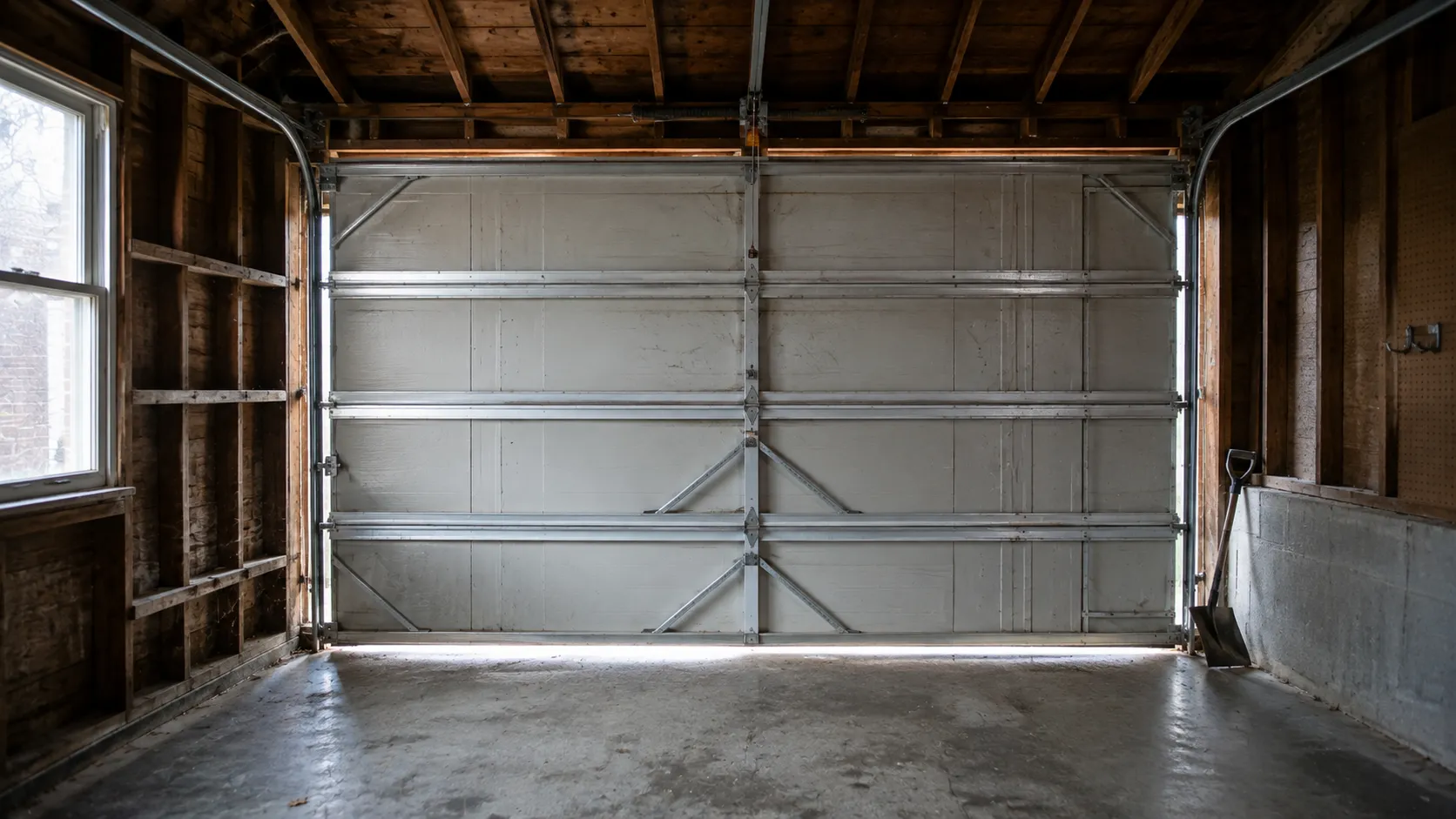
A spring that's lost tension in the cold isn't a tighten-it-yourself repair. On a house built anywhere in that 1938 to 2008 range, the winding bar and clamp setup on an original torsion spring holds enough stored force to break a bone or worse if it lets go wrong, whether that house sits in Westover two miles out or Kingwood eighteen miles away. If the door won't lift, drops fast on the way down, or you hear a loud bang from the garage on a cold morning, that's a broken or split spring, not a lubrication problem.
Same goes for a cable that's frayed or jumped its drum, which shows up more in this climate because cold steel doesn't flex the way it does at room temperature. If your opener is straining, clicking, or reversing on its own below freezing, don't force it with the wall button hoping it'll work through. Repeated forcing burns out the motor and can snap a cable under load.
We don't recommend touching torsion hardware yourself at any age, but on the older end of our 1938-2008 stock, the equipment is old enough that the spring gauge stamped on it may not match anything sold today. That's a phone call, not a Saturday project.
What we find
When Waiting Is Fine
Not everything on a cold morning needs a same-day call. If the door is slow to open but still closes flush and the opener isn't straining, that's usually grease gone stiff in the cold, and it can wait for a milder day and a proper lube job. A little extra noise, a squeal on the rollers that fades once the door's cycled a couple times, is normal for hardware this age and doesn't mean the spring is going. Cosmetic issues, a dented panel from a stray mower or a faded finish on a door that's been through decades of winters, aren't urgent either, since a working door with a bent bottom panel still does its job.
We'd rather you wait a week for a slow day than pay a rush fee for something that isn't actually broken. Where we draw the line: if the door doesn't move at all, drops on its own, or the opener motor is hot to the touch, that's not a wait-it-out situation regardless of the day. Everything short of that, a stiff pull, a groan, a door that's a little heavier than usual in the cold, can sit until it's convenient.
How we work
The Problem
The core issue in this area isn't bad installation or cheap hardware. It's that a big share of the housing stock, most of it from the 1980s-90s wave and running back to 1938 on the old end, was built with torsion springs sized for average use and average temperature swings, not the hard cold snaps this region gets most winters. Steel spring wire has a fatigue life measured in cycles, and cold cuts that life shorter because the metal doesn't flex smoothly. A spring rated for a set number of cycles at room temperature doesn't get the full count once winter starts working on it every year.
Across a service area with close to 20,663 households and 10,952 owner-occupied houses, most of it built in that same window, the same failure mode plays out on the same cold week, year after year. With a median household income of $60,791 across the area, replacing a whole door isn't a decision people make lightly, which is part of why we push for spring repair over full replacement whenever the track and panels are still sound. That's why call volume spikes after the first hard freeze and not really any other time.
Questions
Common questions
Why does my garage door only act up when it's cold out?
Torsion springs are wound steel, and steel loses flex as the temperature drops. Most homes here have springs that were fine in October and lose enough tension in a hard freeze to either slam the door shut or make it too heavy to lift. It's a predictable seasonal failure, not a sign of poor maintenance.
How old does a spring have to be before winter becomes a risk?
Most of the housing stock we work on went up between 1938 and 2008, with a heavy concentration in the 1980s and 90s. There's no single cutoff age, but the older end of that range, especially pre-1970 builds, tends to run galvanized springs with less cold tolerance than newer hardware.
Can a broken spring wait until spring to get fixed?
No. If the door won't lift, drops on its own, or the opener is straining, that's a safety issue regardless of season. Waiting risks a full drop of a heavy door or a burned-out opener motor. Slow-but-working doors and cosmetic dents can wait; a dead spring can't.
Do you replace the whole door or just the spring?
If the track and panels are sound, we repair the spring rather than push a full replacement. Given the median income across this service area, most homeowners want the repair route when it's a safe option, and a spring swap on an otherwise good door is usually enough.
Ready when you are
Need a garage door sorted in Morgantown?
Morgantown Garage Door Pros repairs and installs garage doors, springs and openers in Morgantown, WV and the surrounding area.